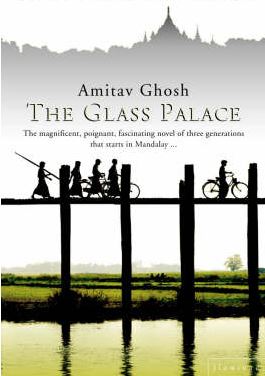
"The Glass Palace"
by Amitav Ghosh.
Chosen by Chris following a chance discovery on a bookshelf in Sweden.
This historical novel has nearly 600pp, 45 chapters 7 sections; the sections helped to keep track.
The setting is India and Burma; the period is from the end of the third Burma War 1885 (with loss of sovereignty) to late 20th Century.
The book uses the story line of a small number of privileged families to illustrate the political, cultural and economic developments in Burma and its relations with India.
To cover such a huge sweep of history inevitably demanded a lot of writing, this was not a book for the faint-hearted.
Plot synopsis, character and family list are all well documented on wikipedia at:
Wikipedia - The Glass Palace
AA Book Club reception:
There was general agreement that this is a very good read, set in unfamiliar territory and cultures.
This is a nuanced look at “Empire” and the exploitation of abundant human and natural resources, specifically the harvesting of teak wood.
There was an intriguing mixture of psychology and sociology and you felt a gradual change in tension with the forces of evil bringing the differing faiths inside the armed forces into conflict.
However, the lack of good maps, a family tree (jungle?), and a glossary was a drawback.
The characters were, and character development was enjoyed.
Rajkumar was particularly well documented from youth to adult to middle age to dotage.
Dolly was well depicted as a person growing up in a sheltered environment suffering from comfort zone challenges.
Various detailed comments from club members were noted including:
On the positive side:
- An easy enjoyable read that gradually became more challenging
- Good parallels with today’s world order
- Loved it, couldn’t put it down
Negative:
- A “Jane Austen binge” was not a good preparation for such an extensive novel.
- This would be better as a history than as a novel
Interesting:
- The mixing of fact and fiction produced a strange result.
- The really interesting parts relate to how people, soldiers, were led to question their sense of identity.
Was Burma an English colony or an Asian country?
How do you decide what and who is valuable?
Doorly score: 3.9
PC. 2026
Extra material, from a member that could not get to the review
I’m sad to miss the discussion about The Glass Palace.
I found it a fascinating book. It was a reread.
I think I’ve mentioned before how I’d had to learn a different way of reading when I took the writing course.
Previously I’d looked at it as an example of how to construct a family saga, reading the book as an instruction for a writer.
This time I read as a reader which opened it up as a whole new experience.
It’s effectively several books isn't it? It is a saga. It’s a descriptive geography plus a history lesson with serious political comment.
It’s very long and would probably have benefitted from a few less main characters.
Despite it being a second read, generations crossed over and it was often difficult to work out who belonged to which parent.
Some of the characters were initially well developed. Rajkumar and Dolly were more or less the constant throughout the book.
The twins Manju and Arjun were a mystery to me and their story felt contrived.
Am I right they were Uma Dey’s nephew and niece? Arjun in particular became a mouthpiece for a cause but it didn’t feel believable.
The storyline about the Indian uprising became confusing and it didn’t engage me enough to try and understand the finer points.
I know the whole situation in that part of the world during the second world war was brutal and confusing. There have been many stories.
We read Tan Wan Eng, The Garden of Evening Mists about Malaysia (I think it was that one). Towards the end of this book I felt the author was tying up loose ends.
Jaya suddenly became a character. She was necessary in order to find Dinu.
Quiet, deep thinking Dinu who had changed, somehow managing to survive censorship in the military junta of Myanmar - with a guest appearance of the former Nobel Prize winning Aung San Suu Kyi.
Can you believe she is 80 years old?
Hers is a sad story that deserves to be told doesn’t it?
The setting of the book was the most interesting for me.
We had visited Myanmar in the window of freedom the winter of 2016 when Dilip first moved to Singapore.
I haven’t had chance to look at all of my photos of that holiday but it remains with me as an amazing place.
I’ll share the few on my year album. The Shwedagon Buddhist temple in Yangon (Rangoon) mirrors the golden hti and is breathtaking.
The people were poor but incredibly welcoming and generous. We have stories about Insein gaol (as in the book), the lost sunglasses and a police parade - for another time.
All in all, the book was well worth persevering at for the prolonged second read. It was all based on his, Amitav Ghost’s, family experience with historical facts interspersed with strong political stances. It demonstrated the cruelty of war, migration, poverty disease and a world that is often unfair.
However I found it hopeful.
I didn’t love the final chapter about the teeth.
I think I know what he was trying to say but it just left me curling my lip up.
|